
Authentic Corn Tortillas At Home
Master The Art With Our Step-By-Step Recipe Guide
Along with the “frijol” or bean, corn has been a staple in Pre-Hispanic America for millennia, with modern day societies spanning the USA, Mexico And Central and South America relying on maize as one of their principal sources of energy
Untreated corn has plenty of fibre, protein and essential vitamins. Unfortunately the bioavailability of some of these nutrients is very poor. Untreated corn is notoriously lacking in vitamin B3, or Niacin, a compound essential for energy production in the body, as well as for the healthy function of the skin, mucous membranes and intestinal lining
Luckily the ancient Americans found that pre-cooking corn in an alkali solution greatly improved its taste. And whether by accident or design, it turns out this treatment, known as nixtamalization, releases that protein and vitamin not otherwise available
The process for making nixtamal from dried corn is in principle quite straight forward, and I describe this in my previous post: field corn is boiled in a solution of limewash for 15 mintues and left to soak overnight, ready for rinsing. The fun really begins with the grinding of this nixtamal into an ultra-fine masa suitable for tortillas
In this post we’re going to go into the process of converting nixtamal into a dough or masa for use in anything from tortillas and its many derivatives. And the steamed or baked dumplings we know as tamales
The process requires some serious grinding. Fortunately, nixtamal is also available in dehydrated flour from, masa harina. I’ll also show you how to source and work with instant corn masa for equally fantastic results, and none of the hard work
Nixtamal Nutritional Benefits
Corn masa, both fresh and from instant masa harina, is rich in a wide range of essential nutrients:
Nixtamal is high in fibre, protein and complex carbohydrates. Depending on the type of corn and preparation method, if has a low to moderate glycaemic index of 46 – 69
It is virtually fat free and is gluten free, thus suitable for people with Coeliac’s Disease and other gluten sensitivities
The presence of soluble fibre and resistant starches also provides significant pre-biotic properties, helping to keep your friendly gut bacteria well fed and healthy
The nixtamalization process also neutralizes antinutrients such as phytic acid. Present in most seeds and grains, phytic acid likes to bind to minerals such as Calcium and Iron, blocking their absorption. This anti-nutrient can be largely deactivated by processes including sprouting, fermentation and nixtamalization
The use of lime-wash (Calcium-Hydroxide) in nixtamalization also adds Calcium, which can now be freely absorbed
Making Corn Masa At Home
The first thing to say on the subject is that there are two basic types of corn masa
1 – Masa For Tamales
Dumplings of various kinds, tamales are made with masa which coarse and a little grainy in texture
Tamales masa can retain a fair bit of the corn kernel’s outer skin without it negatively impacting on its texture. For this reason, and despite what purists will have you think, I find that masa for tamales can be effectively achieved from freshly nixtamalized corn using an electric food processor
You can buy dehydrated nixtamalized instant corn masa which just needs the addition of water. (We’ll show you where you can source this below)
So why would you want to go to the trouble of nixtamalizing your own corn? Because nothing in the world fully reproduces the taste and aroma of real, freshly nixtamalized corn. Our star dish using fresh nixtamal on our yoga retreats is the Pizza Tamalera – an open, baked tamal topped with a medley of vegetables on a Mexican tomato, chipotle chilli and vegetable broth sauce. We’ll be sharing that recipe shortly
2- Masa For Tortillas
Tortilla masa is a different story. This masa has to be silky smooth, free from the kernels’ skin and ground to a fine, non-grainy dough. I have made fantastic tortillas this way, so I know what it takes. (Is it worth it? You bet!)
Removing the skins from the kernels require vigorous rubbing under running water
For grinding, a food procerssor won’t do, as the blades cut rather than crush the corn, and gives a slightly gloopy consistency. I have a hand corn-mill, a bit like a meat mincer, but with two grinding surfaces. The corn has to be passed through at least three times, and even then, it benefits from a final grinding with a traditional stone metate
I really feel that a tutorial on this process would warrant a full YouTube video. It can be done, of course. But for now, let me just recommend that you get yourself a bag of instant masa harina, add water, et voilà: a lovely blob of masa, ready for shaping into tortillas, memelas, gorditas, sopes and so much more
Sourcing Masa Harina
I can’t speak for the rest of the country, but in London you can buy masa harina from the Wholefoods chain, and many independent shops specializing in whole foods. I recently bought a couple of bags from Village Wholefoods on the Pavement in Clapham. I’ve also seen them in Eat17 in Orford Road, Walthamstow
The most popular brand in Mexico is Maseca. Unfortunately tests run in 2018 found high quantities of GMO corn in both their white and blue corn masa. If you’re not bothered by GMO, Maseca is great for authentic taste
Naturelo and Bob’s Mill offer a premium GMO free product with a somewhat higher price tag. My best recommendation is the UK based Cool Chile Company, selling GMO free masa harina plus tortilla presses, and a good selection of Mexican chillies, condiments, canned goods and even ready made tortillas. They have a delightful restaurant, La Taquería, in Westbourne Grove, West London
You can find them online on coolchile.co.uk
Tips For Making Masa From Masa Harina
The process couldn’t be easier. Put some masa harina, AKA instant nixtamal, in a bowl. Some people add a pinch of salt, but tortillas in Mexico are usually unsalted. Gradually add water, stirring with a wooden spoon if you’re using hot water, or your hands if using warm or cold
Texture is important. I like to use hot, not boiling, water as it gives a more cohesive dough that’s easier to work with. Blue corn, in particular, benefits from hot water. The softer, and more common, white corn will form a good dough with warm, or even cold water
Masa Harina is quite absorbent, and what appears to be sufficient water may, after a while, turn out to be too dry. Mix the dough, cover the bowl with a cloth to prevent drying, and wait 5-10 minutes. Then take a golf-ball sized piece and roll it into a neat ball. Flatten it with your hand. The edges should remain intact and not break up. If the edges crack the masa is too dry and needs a little more water. Masa for tortillas is pressed between two (usually plastic) sheets. If the masa is too wet it’ll stick to the plastic and break up as you try to remove it. In this case, simply add a little more masa harina
Check the recipe below for a step-by-step guide for making corn tortillas from masa harina
Home-Made Masa For Tamales
The process of making the basic masa from masa harina for tamales is essentially the same as for tortillas as above
Making masa for tamales from freshly nixtamalaized corn can be done using a food processor or, if you intend to make these often, a hand (or electric) corn mill. the process is described in our previous post
In Summary:
Start by rubbing off some of the skins from the kernels whilst immersed in a bowl with plenty of water. The process of nixtamalization softens these, facilitating the process. As the skins float to the top, discard the water, catching the skins through a strainer. I do this at the sink to stop my kitchen turning into a paddling pool
Once you get bored with this – fortunately masa for tamales is great even with some skins on – transfer the drained corn kernels into a food processor and process until you get a fine, slightly grainy texture
Tamales most often come as dumplings wrapped in corn or banana leaves with a filling. They can also be blind, having no filling, and also baked. Homemade tamales tend to be party food, prepared in quantity for special occasions and fiestas. You will, however, find street sellers all over Mexico selling steamed tamalitos every day of the year for breakfast
Tortillas From Masa Harina- Recipe
Equipment
- Tortilla Press Or a large dinner plate with a flat bottom over a chopping board
- x1 sandwich bag cut into 2 squares
- Skillet
Ingredients
- 1 cup masa harina for tortillas
- 3/4 cup warm water
- pinch of salt (optional)
Instructions
Mix The Corn Masa
- mix the masa harina with most of the warm water in a bowl. Mix using a large spoon, then bring it together into a ball using your hands
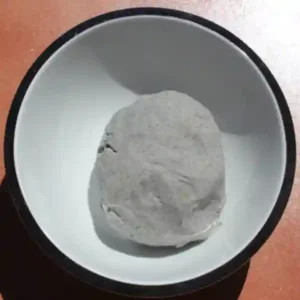
- leave to stand, covered, for 5 minutes
- place a ball of masa on the palm of your hand or chopping board and press down - if the edges crack add a water, a little at a time until the masa ball is soft enough to retain its neat edges when pressed
Make the Tortillas
- heat a seasoned skillet so a drop of water sizzles and form a ball which slides on the pan
- divide the dough ball into eight pieces and shape roll into a ball
- place a plastic sheet on the tortilla press and put a dough ball on top. cover with the second plastic sheet and press down lightly with your hand to flatten it a little
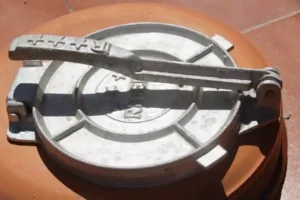
- pop down the lid of the press and press lightly but firmly using the lever
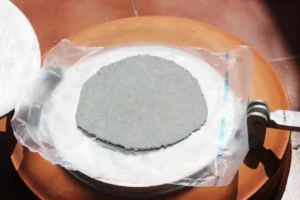
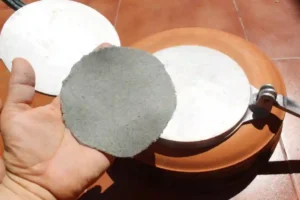
- open the press, peel off the top plastic layer, then rest the tortilla on the palm of your hand, plastic layer uppermost so you can peel it off
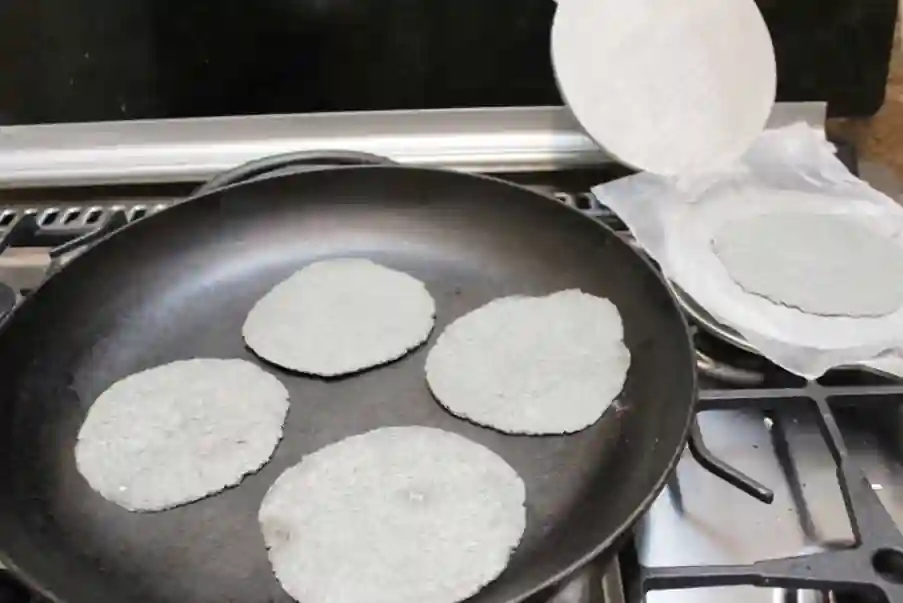
- put the tortilla straight onto the skillet. Depending on the temperature, turn after 60-90 seconds. The cooked side should show just the odd speckle of very light browning
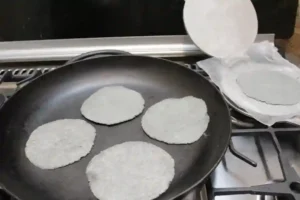
- turn the tortilla with a spatula. If the edges curl sufficiently, you can pick up and edge and turn it with your hands
- cook the second side for a similar or slightly shorter time - you want to see the second surface crack slightly with minimal browning
- If the hydration and temperature is perfect your tortillas will partially or wholly puff up, a sure sign they're ready to serve
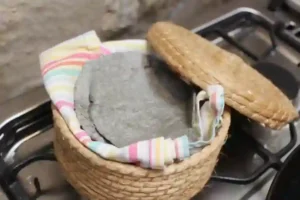
- Place the cooked tortillas in a basket line with a tea towel or some kitchen paper
- if you're making tortillas in batches you may want to give them a last quick firing on the skillet before serving - no more than 3-4 seconds each side so they stay soft
From Masa To 101 Antojitos
Armed with your ball of corn masa you are now ready to create any one of literally hundreds of antojitos, the “little whims” which are such a defining feature of Mexican food
1 – Corn masa may be shaped
- round and thin into tortillas, as per our recipe above
- slightly thicker with a raised edge to hold in topping as with Sopes
- ultra thin and extra large as per the Tlayudas, found in Oaxaca
- thicker and slightly oval for Memelas
- thicker still, with shortening, plus other ingredients such as beans, for Gorditas and Bocoles from Mexico’s Huasteca region
- raw masa may be filled with beans or and dry baked into the oval shaped Tlacoyos, or filled with cheese, then coated in whipped egg and shallow fried for Peneques, etc., etc., etc
2 – Thinly shaped items like tortillas can folded and served with various fillings and sauces like
- tacos and quesadillas – simply folded in half or rolled and filled with cheese, meats, beans and other ingredients such as nopal cactus or courgette flowers
- rolled into thin tubes and fried they become flautas
- steeped in chilli-tomato saucem, folded and sprinkled with fresh cheese they become enchiladas
- the same procedure is followed using beans, green tomatillo sacue or mole (a chilli based sauce, sometimes enriched with bitter chocolate) to create enfrijoladas, entomatadas, and enmoladas respectively
The internet is awash with fantastic recipes for Mexican antojitos. This is the most fun part of cooking with corn masa. When it comes to eating, however, the corn masa is always the star ingredient. Made it at home, additive free, with fresh ingredients, you simply won’t find better antojitos
intro
nutrition
preparation
recipe
variations
Delicious Refried Black Beans Recipe: Quick & Easy Guide
Home Cooked Refried Black Beans Recipe Beans are about the best staple in your store cupboard. Packed with protein, fibre, healthy carbohydrates and essential vitamins and minerals, they are a flavourful, nutritious and economic addition to any meal In the previous...
A Flavourful Fiesta: Cooking Up Perfect Mexican Black Beans
a staple of traditional traditional American societies since antiquity in Europe, we think of Mexican beans as refried. Delicious as they are, before refried beans comes the mother-dish, “Olla de frijoles”
Nixtamalization Of Corn: Secret Of Ancient America
The process of breaking down the outer husk with an alkali, nixtamalization of corn increases the bioavailability of protein, B3 and other essential nutrients, while releasing the full flavour of maize