
Harness The Power Of The Vagus Nerve:
Yoga Exercises For Your Wellbeing
In today’s fast-paced world managing stress and supporting your wellbeing are imperatives. While most of us are familiar with the body’s stress response, its rest-and-digest counterpart has only more recently received due attention. Though organized centrally, rest and digest is mediated by the Vagus, a large nerve exiting the cranium to serve virtually every vital organ. And a major way to activate the Vagus nerve is through the practice of yoga
Few systems enjoy greater popularity today than yoga, an ancient discipline combining gentle movement with mindful attention. Regular yoga practice protects against the most common ailments of our day, from cardiovascular disease and digestive dysregulation to anxiety and depression
In this article we’ll explore the essentials of Vagus nerve function, and how yoga works through the Vagus to heal your mind, body and spirit
What Is Stress?
Before discussing the Vagus’ powerful anti-stress effects, let’s take a brief look at what exactly we mean by stress
At its most basic, stress is your body’s way of dealing with life’s challenges, great or small. While our conscious experience of stress is largely mental-emotional, stress is associated with a series of powerful changes involving multiple organ systems
Under stress, the brain triggers the general adaptation syndrome (GAS), cascade of hormones originating in the brain (hypothalamus), and culminating in the release cortisol from the adrenals to help you deal effectively with stress
The GAS occurs in 3 stages:
- Alarm: an initial response of fight-or-flight, with increased heart rate, blood pressure, and mental alertness. This is mediated through cortisol in tandem with the sympathetic nervous system (see below)
- Resistance: where the body tries to counteract the potential damaging effects of the alarm stage, and return your vital functions back to baseline. The parasympathetic nervous system (see below) mediates these activities via the Vagus nerve
- Exhaustion: where persistent stress finally depletes your body’s energy resources with negative consequences on your physical and mental health
The GAS is a stereotypical response, appearing the same whether you’re experiencing excitement or distress. More recent research, however, suggests mental attitudes such as positive thinking and optimism help to mitigate the ill-effects of stress
Autonomic Nervous System
The GAS works in tandem with the autonomic nervous system (ANS), the part of the nervous system involved in regulating all of your vital internal functions, such as heart and breathing rate, and blood pressure
The ANS consists of two complementary systems:
- the sympathetic nervous system (SNS) creating physiological arousal, also known as fight-flight, in response to stress, and
- the parasympathetic rest-and-digest nervous system (PSNS) returning your body to baseline to replenish your energy resources
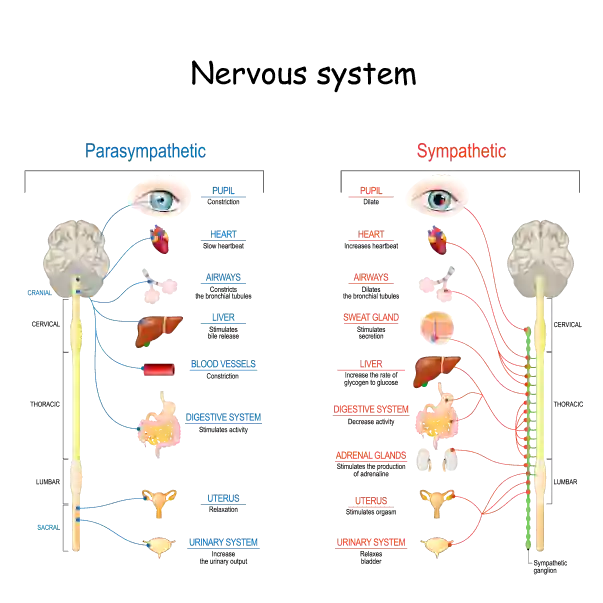
Though their actions are often antagonistic, the two systems work synergistically to produce a level of excitation, or autonomic tone, appropriate to an ever changing physical and mental environment. Check the diagram below to see how the ANS affects the major body systems
Stress And Health
Triggered by stress, the sympathetic nervous system releases the hormone adrenaline and neurotrnasmitter noradrenaline to create the fight-and-flight response
The emergency dealt with, the resistance stage of the GAS kicks in mediated by the parasympathetic and Vagus to return your body to rest-and-digest
While acute stress is healthy and necessary, persistent stress depletes your body’s resources, leading to negative health outcomes
In the short term, chronic stress is linked to functional (psychosomatic) disorders such as abdominal bloating, indigestion, irritable bowel, and mood disorders including anxiety and depression
Longer term, stress is a major factor in some of the commonest diseases of our age, including clinical anxiety, major depressive disorder, obesity, hypertension and cardiovascular disease
The Vagus Nerve
Your Built-In Anti Stress Response
Under resting conditions, the parasympathetic system acts via the Vagus to maintain a state of relaxed calm supporting healing, repair and the maintenance of healthy function
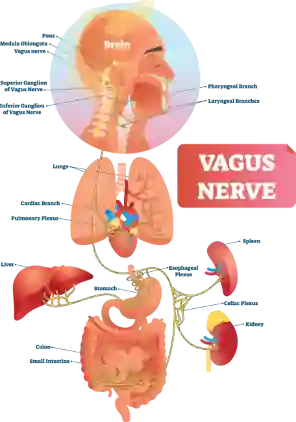
Known as the wanderer, due to its extensive distribution, the Vagus exits from the brain-stem to supply your vital organs. Activation of the vagus is associated with a reduction in heart rate and blood pressure, and a boost in digestive function
The Vagus is strongly anti-inflammatory, supporting immune activity to assist healing and repair
The Vagus Nerve And Yoga
Despite their physical effects, stress and rest are mental appraisals of any given situation as inherently safe or unsafe
Moreover, during stress your body responses are similar whether you’re encountering an external challenge, recalling a past event, or anticipating a future scenario
While in some cases involving past trauma psychotherapeutic support can be invaluable, under normal conditions yoga can help you shift the brain bias in the direction of rest
Studies show that mindful practices such as yoga, tai ‘chi, Pilates, and others have a powerfully relaxing effect, decreasing key markers for physiological stress
The Vagus As Mind-Body Link:
The Gut Brain Axis
We’ve already seen how the GAS together with the autonomic nervous system links your mental state with your body physiology
The Vagus distributes parasympathetic signals to the organs, but the Vagus contains nerve fibres serving different functions, including the control of the voluntary muscles of speech and importantly, sensory fibres from areas of the skin AND the internal organs. In fact as much as 80% of the Vagus is sensory
The Vagus is a major component of the gut-brain axis, a two-way link between the internal organs with the brain
An major new area of study that is finally getting is due is the microbiata, those friendly microbes living in your gut. We are only just starting to appreciate their essential contribution to many areas of our health.
In addition to regulating local digestive functions, your gut bugs are involved in many essential processes, from immune function to mental health. For example we now know that the microbiata is a major source of the neurotransmitter serotonin. Though its main action is to mediate brain circuits linked with mood regulation, as much as 95% is produced by bacteria in the gut!
Just as your mood can influence your gut health, so do gut bacteria communicate with your brain. And the Vagus is the principle connector in this two-way gut-brain feedback loop
Does Yoga Stimulate The Vagus Nerve?
Direct stimulation of the vagus kicks off with the development of a technique to send an electric current to the nerve for the management of certain treatment-resistant conditions
Currently licensed solely for the treatment of epilepsy and depression, the wellness community have embraced Vagal stimulation, claiming to do so by means of pressure, massage, exercises and even cold applications. But can yoga really stimulate Vagus nerve?
A common indicator of Vagal activity is the so-called heart-rate-variability (HRV). This is calculated as the difference in heart rate during inhalation and exhalation. Though there is some controversy around its accuracy, HRV is increasingly considered as a reliable measure of vagal tone
- In a 2016 comprehensive review of the literature A. Tyagi and Marc M Cohen found that despite their poor methodology:
the reviewed studies suggest that yoga can affect cardiac autonomic regulation with increased HRV and vagal dominance during yoga practices. Regular yoga practitioners were also found to have increased vagal tone at rest compared to non-yoga practitioners
- More recently a 2023 systematic review by Rani Jose et al concludes that:
Physical exercise, breathing exercise, diet, music, and mind-body interventions such as yoga and meditation were identified as the factors enhancing HRV or predictors of HRV
If the evidence for yoga stimulating the Vagus needs further elucidation, yoga’s ability to reduce stress markers is firmly established
Yoga Benefits Mediated By The Vagus
Studies show that regular yoga practice improves the major risk factors for cardiovascular disease. By reducing physiological arousal yoga helps to
- lower blood pressure and
- improve the cholesterol profile
shifting the balance in favour of good cholesterol, while reducing the total levels of circulating fats
A systematic review by Cramer et al (2014) on risk factors for cardiovascular disease concludes that yoga is an effective:
ancillary intervention for the general population and for patients with increased risk of cardiovascular disease
Another systematic review (Alra, 2022) compared yogic interventions with usual care and non-pharmacological treatment in patients with cardiac disease. The team found strong evidence of effectiveness of yoga interventions on:
lipid profile, blood pressure, and psychosocial outcomes in patients with diagnosed cardiac diseases
Yoga is linked to improvements in digestive health and associated mood-related symptoms in disturbances including
- irritable bowel (IBS) and
- inflammatory bowel disease (IBD)
A 2024 systematic review (Thakur et al) looked at the effects of yoga on digestive disorders, including IBS, IBD, chronic pancreatitis and gastrointestinal cancer, The authors concluded that:
yoga appears to be safe and has potential to improve functioning across a spectrum of gastrointestinal diseases
The therapeutic effects of yoga on anxiety, depression and other aspects of emotional and cognitive health are equally compelling
Systematically reviewing 25 studies, M C Pascoe et al (2015) conclude:
yoga practice leads to better regulation of the sympathetic (fight-flight) nervous system and hypothalamic-pituitary-adrenal system, and a decrease in depressive and anxious symptoms in a range of populations
Another review led by J Martinez-Calderón (2022) looked at yoga for anxiety and depression, concluding that:
yoga-based interventions may help to improve mental health in adults diagnosed with anxiety or depressive disorders
Yoga Postures For Vagal Stimulation
There is little evidence to support the idea that specific yoga exercises provide discreet benefits. Yoga is a holistic discipline and cannot be reduced to component parts. It is when practiced as an integral system that yoga shines as a powerful promoter of health
That said, let’s look at how yoga postures and exercises might influence Vagal activity
Yoga may directly stimulate the Vagus at the level of the
- neck,
- chest
- and abdomen
through breath, pressure and other stimuli
Commonly recommended exercises to stimulate the Vagus include
- Kapala Bhati (Shining Skull) and Bhastrika (Bellows) breathing
- Chest opening back-bends, such as the Cobra (Bhujangasana), Camel (Ustrasana) and Bow (Dhanurasana)
- Inversions, such as shoulder (Salamba Sarvangasana) and head stand (Shirshasana)
- Any and all of the 3 locks (Bandhas) may also stimulate the Vagus
The relative effectiveness of different yoga schools, styles and methods on vagal stimulation remains unknown. One reads, for example, that restorative or yin yoga are good options for increasing vagal tone. And they are, certainly. But are they superior to other methods? Assuming outcomes based on presumptive mode of action is at best unreliable. And may even be misleading
The results of an intervention can be known only by studying outcomes. And practiced as a holistic system of postures, breath-work and mindful focus, yoga has amply demonstrated its full health potential
Therefore, choose a yoga practice that resonates with your qualities, and that you enjoy. Move fast, or go slow. But always pay attention: yoga is none other than meditation
Check out my weekly online therapeutic yoga class
Yoga Practical
1: BODY SCAN
Try this simple mindfulness exercise focused on the body
The video below guides you through a basic body scan in preparation for a deeper relaxation practice known as yoga yoga nidra
Yoga Breathing And The Vagus
Considered the principal manifestation of the vital force (prana) within the body, breath is at the centre of all yoga practice. Breath is a vital mind-body link, it’s condition revealing your mental state, as much as your mental state reflects the pattern of your breathing
Breath regulation is a powerful stimulator of Vagal parasympathetic activity, bringing about positive and lasting changes to your wellbeing
Pranayama: Breath As Vital Life Force
Practical: Breathing For Vagus Nerve Activation
The subject of breath-work is large, with many ramifications and practical applications. Breath is a powerful stimulator of the Vagus nerve
Breathing directly influences the autonomic states of anxiety and calm. We discuss the impact of breathing and overbreathing in some depth in my article on breathing pattern disorder
Yoga breathwork, or pranayama, translates as restraint (yama) of the the vital air (prana). Prana is subtle energy, or life-force. It manifests in the body as breath, and in the mind as thinking and feeling
When prana moves the body is active and the mind thinks and feels. When prana is still the mind is clear and calm and the body rests
Underlying the countless classical classical and modern takes on breathwork, the underlying principle of pranayama holds: breathe less. Calm, quiet breathing is associated with parasympathetic activity, soothing the mind and relaxing the body
Practical
Sit comfortably, or lie on your back
Breathing in and out through your nose notice where you feel the breath: in the various parts of the nose and throat; is your chest breathing? Is your belly moving with your breath? Does your breath reach your lower ribs? At the from. the sides, or the back? Use your hands to help you, if you like
Is there a place in the torso where you don’t feel the breath at all? Mentally soften this area, and see if you can feel it respond to the breath. Don’t try to direct the breath in any way. Just soften areas of tightness and observe. Nothing may change. That’s OK
Now as you let the breath go, exhale quietly and slowly through your nose. Let the exhalation tail off and finish completely. Now wait a moment. Does the breath restart immediately, or is your body comfortable pausing before inhaling?
When the breath comes accept it. Notice where in your body yo can feel the inhalation, followed by the exhalation
Practice breathing this way, initially for a minute or two, building up to 5 minutes as you gain familiarity and experience
Final Words
The available evidence strongly supports a role for yoga as a tool to promote health and happiness. And it achieves this through the calming effects of the parasympathetic nervous system, and its messenger, the Vagus nerve
So, find a style that you enjoy, that you feel motivated to practice regularly. Work with a teacher who understands your needs and supports your goals. Or practice in splendid isolation in your own safe place. Move fast, or go slow. But always pay attention: for meditation is the soul yoga
Above all, enjoy, enjoy, enjoy
Body Work Or Energy Healing: What Is Cranial Osteopathy?
Originally a method for treating the cranium, modern cranial osteopathy is a gentle, minimally invasive treatment modality for the whole body
Hatha Yoga Benefits For Your Physical And Mental Health
From greater strength, mobility and fitness, to improved physical and mental health, discover the science behind hatha yoga’s remarkable health benefits
Yoga And The Mind Body Connection
Understanding how the mind and body connect is the springboard for practical strategies to enjoy a healthier, happier life